
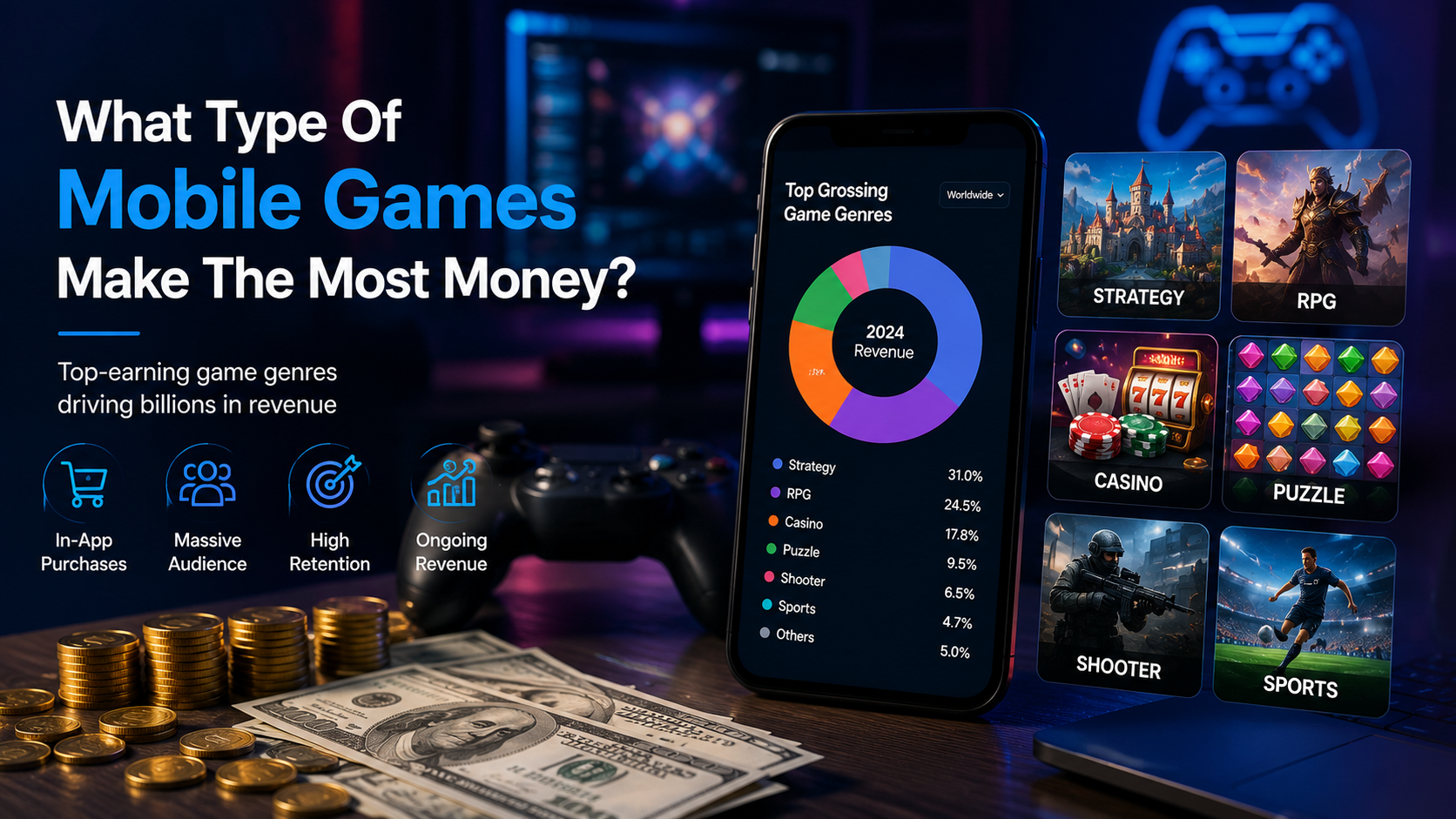
The mobile gaming industry makes billions every year, yet most mobile games barely earn enough to survive. That gap surprises a lot of people when they first enter the market.
A game might have impressive graphics, smooth gameplay, and strong reviews, but still fail financially. Meanwhile, another game with relatively simple mechanics suddenly dominated app stores for years.
That’s why studios often spend more time studying monetization psychology than graphics pipelines. A successful mobile game development company usually understands this early: profitable mobile games are not always the most technically advanced ones.
They are the ones designed around long-term player behavior.
And that changes everything.
Mobile Gaming Is Built Around Retention
Before talking about genres, it helps to understand one thing:
Revenue in mobile gaming mostly comes from retention.
If players leave after one day, monetization usually collapses. It doesn’t matter how polished the game looks.
Games that generate the highest revenue tend to keep players engaged for:
- weeks
- months
- sometimes years
That long-term engagement creates opportunities for:
- in-app purchases
- subscriptions
- ads
- battle passes
- cosmetic upgrades
Games like Clash of Clans became massive earners because players stayed invested over long periods rather than completing the game quickly and leaving.
1. Battle Royale Games
Battle royale games became one of the biggest money-makers in mobile gaming over the last decade.
These games combine:
- competitive multiplayer
- cosmetic monetization
- seasonal updates
- live events
The important part is not just gameplay. It’s the recurring engagement loop.
Players return constantly because:
- rankings reset
- new skins release
- Events create urgency
- friends continue playing
Games like PUBG Mobile and Fortnite proved how profitable cosmetic-driven economies can become without directly forcing gameplay purchases.
That model changed the industry.
2. Strategy Games
Strategy games quietly generate enormous revenue.
They may not dominate social media conversations as often, but financially, they perform extremely well because of long-term player investment.
These games often include:
- base building
- alliance systems
- progression timers
- premium accelerators
Once players invest enough time into progression, they are more likely to spend money protecting or accelerating that progress.
Games like Rise of Kingdoms are strong examples of retention-heavy monetization systems.
Strategy games also benefit from community dynamics. Players stay because their alliances depend on them.
3. Gacha Games
Gacha systems are among the highest revenue-generating models in mobile gaming.
These games revolve around randomized character or item collection systems.
Players spend money on:
- rare characters
- limited-time items
- upgrade materials
- event banners
Games like Genshin Impact generate massive revenue partly because of emotional attachment to collectible characters, combined with ongoing content releases.
This model works exceptionally well when:
- Content updates remain consistent
- Characters are emotionally marketable
- Progression systems stay active long-term
Though highly profitable, gacha systems are also controversial because they overlap psychologically with gambling mechanics.
4. Casual Puzzle Games
Casual games may look simple, but financially, they can outperform more complex genres.
Why?
Because they attract broader audiences.
Puzzle games appeal to:
- older demographics
- non-traditional gamers
- short-session players
Revenue often comes from:
- rewarded ads
- optional boosters
- extra lives
- progression shortcuts
Games like Candy Crush Saga became incredibly profitable through massive user volume rather than hardcore player spending.
Casual gaming thrives on accessibility.
5. Simulation And Life Management Games
Simulation games generate strong long-term engagement because players build routines around them.
These games include:
- farming simulators
- city builders
- life simulation systems
- restaurant management games
Players return daily to maintain progress.
Games like Roblox also benefit from user-generated ecosystems where players continuously create and consume new content.
That dramatically increases lifetime retention.
6. Sports And Competitive Multiplayer Games
Sports games consistently perform well because they already connect to massive real-world fanbases.
Mobile sports games monetize through:
- team packs
- player upgrades
- seasonal content
- online competitions
Titles connected to football, basketball, or racing communities often maintain stable player bases year after year.
Competitive multiplayer also encourages recurring spending because players constantly seek progression advantages or customization options.
7. Idle And Incremental Games
Idle games are surprisingly profitable despite minimal gameplay complexity.
These games focus on:
- automated progression
- resource accumulation
- constant upgrades
They work because they trigger repeated reward loops with very low mental effort from players.
Monetization often comes from:
- speed boosts
- premium currencies
- progression multipliers
They are cheaper to produce compared to AAA-style games, which improves profit margins significantly.
Why Free-To-Play Dominates Revenue?
Most high-earning mobile games are free to download.
That sounds counterintuitive until you look at user behavior.
Charging upfront reduces downloads dramatically.
Free-to-play models remove the entry barrier, then monetize through:
- cosmetics
- progression systems
- convenience purchases
- ads
This model works because only a small percentage of users need to spend heavily for the game to become highly profitable.
The Role Of LiveOps In Revenue Growth
LiveOps has become one of the biggest drivers of mobile gaming revenue.
LiveOps refers to ongoing game management after launch:
- events
- seasonal updates
- timed offers
- limited rewards
- content expansions
Games that stop updating usually lose momentum quickly.
Successful titles behave more like ongoing services than finished products.
That’s one reason modern mobile game development cost planning often includes post-launch staffing, analytics systems, and content production rather than focusing only on initial development.
Do Better Graphics Mean More Revenue?
Not necessarily.
Some of the highest-earning mobile games are visually simple.
Graphics help attract attention initially, but long-term monetization usually depends more on:
- retention systems
- progression pacing
- social interaction
- reward loops
A beautiful game with weak retention often struggles financially.
Meanwhile, simpler games with addictive progression systems can generate enormous revenue for years.
What Monetization Models Work Best?
Different genres rely on different monetization structures.
1. In-App Purchases
Most profitable for:
- strategy games
- RPGs
- gacha systems
2. Cosmetic Purchases
Most effective in:
- Battle Royale games
- multiplayer games
- competitive ecosystems
3. Rewarded Ads
Common in:
- puzzle games
- casual games
- idle games
4. Subscriptions And Battle Passes
Increasingly popular because they create recurring revenue streams.
Why Community Matters So Much?
The most profitable mobile games rarely succeed through gameplay alone.
Community keeps games alive.
Features like:
- clans
- multiplayer events
- guild systems
- social rankings
create emotional investment beyond mechanics.
Players often stay because of friendships or team commitments rather than the gameplay itself.
That social layer dramatically improves retention.
Final Thoughts
The mobile games that make the most money usually share one thing in common: they are designed for long-term engagement rather than short-term downloads.
Battle royale games, strategy titles, gacha systems, puzzle games, and multiplayer experiences dominate revenue because they keep players returning consistently.
And while flashy graphics help marketing, profitability often comes down to psychology, progression pacing, and community-driven retention systems more than raw technical complexity.
That’s why some simple mobile games quietly outperform visually stunning projects that cost far more to build.