
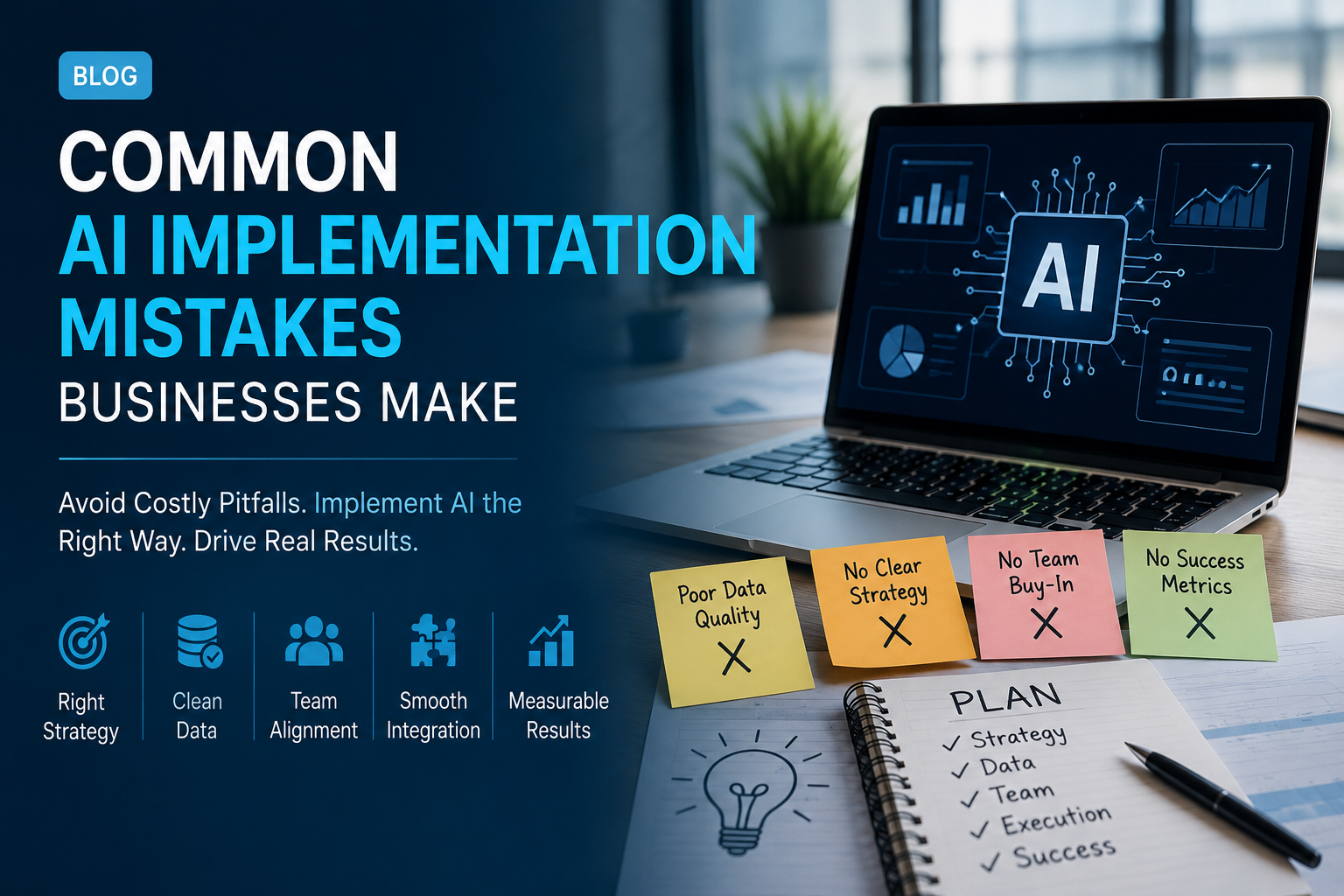
You brought in the tool. You got the demos. Leadership signed off. And then three months later, nothing is working the way it was supposed to. Sound familiar? You are not alone. The most common AI implementation mistakes businesses make have nothing to do with the technology itself.
Skipping proper planning, working with dirty data, and throwing AI at the wrong problems are what sink most projects. And the frustrating part is that all of it is completely avoidable.
If you are in the middle of a rollout that feels sideways, or you are about to start one and want to get it right, keep reading. This is the honest breakdown no one gave you before you started.
What Is an AI Implementation Strategy and Why Do Most Businesses Skip It?
An AI implementation strategy is a clear, structured plan that defines what problem AI will solve, how it will be deployed, what your team needs to do differently, and how you will know if it is working. That is really it. It does not have to be a 50-page document. But it does have to exist.
Most businesses skip it because they are in a rush. A competitor announced an AI initiative. The CEO saw something at a conference. The sales team wanted better lead scoring yesterday. So the company picks a tool, tells IT to set it up, and expects results by the end of the quarter.
That is not an AI implementation strategy. That is a gamble.
The businesses that actually see results from artificial intelligence implementation start by asking the hard questions first. What specific problem are we solving? Is our data ready? Does our team have the capacity to adopt something new right now? What does success look like in six months? Without answers to those questions, you are just spending money and hoping.
An honest AI business strategy takes maybe two to four weeks to put together properly. And it saves months of cleanup on the back end. Every time.
Why Do AI Projects Fail? The Real Reasons
Here is the thing most vendors will not tell you. The technology almost never fails. What fails is everything around it.
Poor data quality is the number one silent killer of AI projects. AI learns from data. If your data has duplicates, gaps, inconsistencies, or is just outdated, your AI outputs will reflect all of that. Businesses spend thousands on AI tools and then feed them years of messy CRM records and wonder why the results do not make sense.
The second big reason AI projects fail is that nobody defines what winning looks like. I have talked to companies that ran AI deployments for six months without a single agreed-upon KPI. When leadership asked whether the project was working, the answer was a shrug. That should never happen. This is one of the most common AI implementation mistakes, and it often leaves businesses unable to measure ROI or improve results.
Wrong use case selection is another issue that comes up constantly. Some business problems are genuinely well-suited to AI. Others are not. Picking a complicated, high-visibility use case to impress the board instead of focusing on the most painful, most solvable problem is a mistake that derails projects early.
Then there is the human side of things, which almost everyone underestimates. Employees who were not involved in the decision, were not trained on the tool, and were not given a clear reason to trust it will quietly work around it. Or they will use it incorrectly and blame the AI when things go wrong. Change management is not optional. It is the whole game.
The Most Common AI Implementation Mistakes and How to Avoid Them
Let’s get into specifics. These are the mistakes I see most often, and every single one of them is fixable before it starts.
Skipping the AI readiness assessment
Before you spend anything, you need to know whether your business is actually ready. Do you have clean, accessible data? Do you have the internal skills to manage AI tools once they are live? Are your existing systems compatible with what you want to build? An AI readiness assessment answers all of this upfront. Without it, you are starting a construction project without checking if the foundation is solid.
Choosing the wrong AI use case
Not every problem needs AI. Some need a better process or some need a better training program. Also, some just need a simpler tool. The mistake is picking the use case that sounds most impressive rather than the one that would have the most real impact. Start with a problem that is specific, measurable, and genuinely painful. AI-powered customer support, business process automation, or predictive analytics for inventory management are real problems with real solutions. “Let’s use AI to optimize everything” is not a use case. It is a wish.
Ignoring data quality
This one is so common and so preventable. Businesses jump into AI deployment without ever auditing the data that will power it. Duplicate records, missing fields, inconsistent formats, outdated information. All of it makes your AI less accurate and less useful. Clean your data before you do anything else. Not during the project. Before.
No employee training or change management plan
Your team did not vote for this. If nobody explains how AI helps them personally, not just the company, they will resist it. Or they will nod along in the training session and then go back to doing things the old way. A real change management plan involves employees early, communicates clearly, and provides hands-on AI training and workshops that actually reflects how they will use the tool day to day.
Underestimating integration complexity
AI does not live in isolation. It has to connect to your CRM, your ERP, your existing workflows, your databases. AI CRM integration and AI ERP integration always take longer and cost more than the initial estimate. Plan for that. Build extra time into your timeline. Test everything before you go live.
No success metrics or KPIs
Define what success looks like before you start. Response time improvement? Cost per lead reduction? Customer satisfaction scores? Pick your numbers, record where you are today, and track them weekly after deployment. If you cannot measure it, you cannot manage it and you definitely cannot justify the investment to leadership.
Skipping AI governance and ethics planning
This gets skipped at smaller companies all the time, yet it remains one of the most overlooked AI implementation mistakes. Who owns the AI outputs? What happens when the AI makes a wrong call? How do you handle data privacy? These are not hypothetical questions. They are real risks that require clear policies, and they are much easier to address before you go live than after something goes wrong.
Trying to do everything at once
Big bang AI transformation almost never works. Businesses that try to automate every process at the same time end up with a chaotic, half-working system that nobody trusts and nobody uses correctly. Phase it. Start with one process, prove it works, then expand. Every successful AI adoption strategy I have seen follows some version of this approach.
How Do Businesses Successfully Implement AI?
The businesses that get AI right follow a consistent pattern. It is not complicated. It is just disciplined.
They start with an honest assessment of where they are today. What data do they have? What processes are broken or inefficient? Where is time and money being wasted most? Then they build a strategy around one or two high-impact use cases and define clear, measurable success criteria.
From there, they run a pilot. A small, controlled test with real data and real users. The pilot is not about proving AI works in theory. It is about proving it works for their specific business, with their specific team, on their specific problem. If the pilot fails, they learn why and adjust before scaling. If it succeeds, they have proof before they invest further.
Then they scale gradually, with proper training and change management at every step. And then they optimize, continuously monitoring performance, gathering feedback, and improving the system over time.
That is the AI tools implementation roadmap that actually delivers results. Assessment, strategy, pilot, scale, optimize. Simple in concept, serious in execution.
This is also where working with experienced AI consultants makes a measurable difference. A trusted AI implementation partner has seen what works and what does not across different businesses and industries. They help you avoid costly mistakes, develop a practical AI implementation strategy, accelerate deployment, and significantly shorten the learning curve, improving the chances of long-term success.
How Long Does AI Implementation Take and How Much Does It Cost?
The honest answer is that it depends, and anyone who gives you a firm number without understanding your business first is guessing.
For a focused pilot project, you are typically looking at four to eight weeks from scoping to deployment. A full-scale AI transformation across multiple business functions can take anywhere from six to eighteen months. The timeline depends heavily on your data readiness, your team’s capacity to absorb change, and how complex your integrations are.
On cost, small business AI implementation covering things like AI chatbot development, basic workflow automation, or an AI email assistant typically runs between five thousand and thirty thousand dollars depending on complexity. Enterprise AI implementation with custom AI solutions, full CRM and ERP integration, and ongoing support is a different scale entirely, often fifty thousand to several hundred thousand dollars over the full project.
Here is the most important thing about cost though. Doing it right costs less than doing it wrong. A failed AI project wastes money, time, team morale, and leadership trust. A well-planned one pays for itself.
AI Implementation Best Practices That Actually Work
Start small. Pick one process, one team, one workflow. Prove the concept works in your environment before you expand it.
Clean your data before anything else. Not midway through the project. Not after the first sprint raises red flags. Before. Your AI is only as good as what you feed it.
Get leadership buy-in early and make sure it is visible. When employees see that leadership is genuinely committed to the AI adoption strategy, they take it seriously. When leadership is ambivalent, the project stalls at every turn.
Train your people properly. Not a one-hour walkthrough webinar. Invest in AI training and workshops for businesses that provide hands-on, practical learning and show employees how AI makes their specific jobs easier and more efficient. People do not resist technology. They resist changes that feel threatening, confusing, or pointless.
Measure everything from day one. Set your baselines before deployment, track your KPIs weekly, and share progress with your team regularly. Visible results build trust, encourage adoption, and create momentum for future AI initiatives.
Iterate constantly. AI implementation is not a project with a finish line. It is an ongoing process of improvement and optimization. The businesses that achieve lasting success with AI treat it like a continuously evolving capability rather than a system they install once and forget about.
How Can Small Businesses Adopt AI Without Losing Their Mind?
Small businesses often assume AI is only for enterprises with massive budgets and dedicated data science teams. That assumption is holding a lot of companies back.
The entry points for AI integration for small businesses are genuinely accessible right now. An AI chatbot can handle customer inquiries around the clock for a fraction of what a part-time hire costs. Workflow automation tools can eliminate repetitive admin tasks that eat up hours every week across your team. An AI email assistant can draft responses, sort inquiries by priority, and flag what actually needs your attention.
The key for SMEs is starting with one painful problem and solving it completely before moving on. Do not try to automate your entire business in month one. Solve the biggest operational challenge first, prove the value, and scale gradually. Investing in AI training and workshops for businesses alongside implementation helps employees adopt AI faster, improve productivity, and drive measurable business results.
Cevra AI specializes in helping small and mid-sized businesses adopt AI through practical, results-driven AI consulting and business automation solutions. Instead of adding unnecessary complexity, we focus on implementing AI that fits the way your business already operates. From identifying the right opportunities to deployment, AI training and workshops for businesses, and ongoing optimization, our goal is to help you achieve measurable results faster. If you’re unsure where to begin with AI, the right guidance can help you avoid costly mistakes, accelerate adoption, and cut months off your implementation timeline.
How AI Consultants Help Businesses Avoid These Mistakes
A good AI consultant does not just show up and recommend software. They help you figure out whether you are ready for AI, which problems are actually worth solving with it, and how to build a plan that your team can realistically execute.
What experienced AI consultants actually do is map your existing business processes, identify the highest-value automation opportunities, assess your data quality and readiness, design your implementation roadmap, manage the technical integration work, and train your team throughout the process. They have also seen what goes wrong at each stage and know how to build around those failure points before they become problems.
The return on good AI consulting services is not just the working product at the end of the project. It is all the budget and time you did not waste going down the wrong path.
Frequently Asked Questions
What are the biggest AI implementation mistakes?
The biggest mistakes are skipping an AI readiness assessment, picking the wrong use case, ignoring data quality, failing to train employees, and trying to scale everything at once. Most AI project failures come from poor planning, not bad technology.
Why do most AI projects fail?
Most AI projects fail because of unclear goals, poor data quality, lack of employee buy-in, and underestimating how complex integrations really are. Businesses that rush into deployment without a real AI implementation strategy almost always run into serious problems.
How long does AI implementation take?
A focused pilot project typically takes four to eight weeks. Full enterprise AI implementation across multiple systems and teams can take six to eighteen months depending on data readiness, integration complexity, and the scope of change management required.
How much does AI implementation cost?
Small business AI projects typically range from five thousand to thirty thousand dollars. Enterprise-scale AI transformation usually runs from fifty thousand to several hundred thousand dollars over the full project lifecycle, depending on scope and customization.
How do AI consultants help businesses?
AI consultants assess your readiness, identify the right use cases, design your implementation roadmap, manage technical integration work, and train your team throughout. They help you avoid the mistakes most businesses only learn about after spending money on them.
Wrapping Up
AI is not going to fix a broken process, rescue a messy database, or win over a team that does not understand why the change is happening. However, when AI is implemented with a clear strategy, supported by clean data, introduced in phases, and reinforced through AI training and workshops for businesses, it can transform daily operations, improve productivity, and deliver measurable business results.
The AI implementation mistakes covered in this guide are not rare exceptions. They are the challenges most businesses face during AI adoption. The good news is that every one of them can be avoided with proper planning, experienced guidance, and a practical implementation strategy.
At Cevra AI, we help small and mid-sized businesses successfully adopt AI through practical AI consulting, business automation, and AI implementation services tailored to real business needs. We focus on delivering solutions that improve efficiency, streamline workflows, and create lasting value without unnecessary complexity or enterprise-level costs.
You do not have to navigate AI adoption alone. With the right strategy and the right implementation partner, your business can avoid costly mistakes, accelerate AI adoption, and build a foundation for long-term growth and innovation.